

A while back I watched a video of some rock climbers reviewing various jumps in Uncharted 4, and they were amazed by some of them because of how "unrealistic" they were—or rather, you'd have to be a real professional to pull off those moves
While this game is known for its stunning visual aesthetics and detailed, realistic world, it does carry certain deviations from realism, especially in its jumping and parkour system, which remains fun despite not being realistic
In this article, you'll learn about the principles of realistic simulation in detail, and how this "unrealism" contributed to the success of games like Uncharted. I'll go over the benefits of realistic simulation in different video games and its effect on the gameplay experience
But I won't skip over the downsides of excessive realism, and how it can weigh a game down and hinder its fun
You'll learn how to determine when realistic simulation is necessary for a game's success, and when player enjoyment is the higher priority, through a close analysis of some practical examples
This knowledge will help you on your journey as a game developer, enabling you to make the right decisions when designing your future games, and to find that perfect balance between realism and fun
Jump Realism in Uncharted: A Case Study
Let's start with my first example, since I'm familiar enough with it and it highlights this delicate equation between realism and gameplay fun well: the jumping system in "Uncharted"

Instead of accurately simulating gravity and air resistance, we find that the character's jumps are unexpectedly high, granting the player far more freedom of movement than would be expected in the real world. This fundamental difference doesn't lower the game's quality—it enhances it
It makes controlling the character easier, and gives the player a sense of capability and control, which encourages exploration and interaction with the game environment in creative ways
Had the character's jumps been fully realistic, movement might have become slow and boring, constrained by exhausting physical laws that could hinder the game's pacing, causing it to lose some of its excitement
Here, we see how breaking realism, deliberately and consciously, serves and improves the player's experience rather than hindering it. The game's goal isn't to accurately simulate the real world, but to create an enjoyable interactive experience
In "Uncharted," the simplified jumping system contributes to achieving this goal perfectly, delivering a smooth, enjoyable gameplay experience that goes beyond the limits of strict realism in favor of the player's fun and experience. The system, in this form, isn't an obstacle—it becomes an effective tool for enhancing the gameplay experience
The Benefits of Realistic Simulation in Video Games
There are plenty of great benefits that video games gain from embracing realistic simulation. Although simulation isn't a goal in itself—not for every game—it's a powerful tool employed to enhance the gameplay experience, giving it unmatched depth and excitement
When games improve their simulation of the real world, they contribute to a noticeable increase in immersion. The player interacts with a virtual environment that feels realistic, making them feel fully absorbed into the game world, and giving them a sense of genuinely existing within it
This immersion translates into a more exciting and thrilling gameplay experience, one that keeps the player on the edge of their seat for hours
In addition, realism contributes to strengthening the sense of difficulty and challenge. The closer a game's simulation gets to reality, the greater the mastery it demands, which gives the player's success the special flavor of a real achievement
Overcoming challenges simulated with high precision generates a deep sense of accomplishment and pride, quite similar to the feeling that accompanies achieving something in real life
This feeling boosts satisfaction with the game and encourages the player to keep going and discover the surprises and challenges it holds
It's worth noting that many successful games have struck a perfect balance between realism and fun, delivering a satisfying gameplay experience for players thanks to this well-considered balance—like the "Sims" series, which simulates a character's life realistically but doesn't lack an entertaining side, or even some racing games that focus on precisely simulating cars and physics, creating an experience very close to reality while still keeping the entertainment factor central
The Downsides of Excessive Realistic Simulation
This article originally set out to discuss how to avoid this kind of simulation, but only the excessive kind—because in your pursuit of accurately simulating the real world, you might sacrifice things fundamental to the gameplay experience
The challenge lies in finding the right balance; excessive fine detail, which might look great in theory, can turn into a heavy burden on the player
Imagine, for example, a game that requires precise mastery of realistic physics in every movement—it could become extremely difficult, frustrating, and out of reach for many. This absolute precision could strip the game of its essential fun and entertainment, turning it into a grueling chore instead of an enjoyable experience
Think of flight simulation games, for instance—some of them offer an extremely high level of realism, requiring the player to have advanced knowledge of flight mechanics and to monitor dozens of gauges, which narrows the player base and drives away casual players from trying them
The same applies to racing games, where extremely fine-grained control can be exhausting for players who are looking for a racing experience rather than control over every tiny detail of their car
Beyond that, this excessive realism can constrain designers' creativity—instead of focusing on designing a fun and exciting world, they're forced to spend a long time precisely simulating a reality that might not even suit the game's environment!
In other words, chasing absolute realism can backfire, turning the gameplay experience from an enjoyable journey into a complicated chore, stripping away the spirit of fun that's the very essence of video games
When Is Realistic Simulation Necessary?
Going back to the flight simulation example, and given that the goal is to teach the "player" how to fly, we can't ignore precision and realism in simulating aerodynamics and the physical laws governing the aircraft's movement
Even a small inaccuracy in this simulation could lead to disastrous results, not just from the game's own perspective, but it could also hinder the player's learning of real-world procedures if they're using the game as a training tool
Then there are medical simulation games, which represent a unique case that clearly highlights the importance of realism. In these games, extreme precision is required in simulating surgical procedures, symptoms, and drug interactions
Not just to ensure an enjoyable gameplay experience, but also to guarantee a useful educational experience for medical professionals or students in the field. Any deviation from reality could lead to severe consequences, whether at the level of the game itself or—more importantly—at the level of learning and training
In short, realistic simulation becomes necessary when the nature of the game requires high precision in simulating a real system or process, or real-world training, where this precision represents the fundamental pillar of the game's success, whether in terms of fun or in terms of its educational or training purpose
In these cases, realism isn't merely an optional element—it's the very essence of the game itself
When Is Gameplay Fun More Important Than Realism?
Imagine yourself playing a classic platformer, the kind that requires precise, chained jumps across nearly impossible slopes and obstacles in the real world. Would you expect those jumps to follow the actual laws of physics?
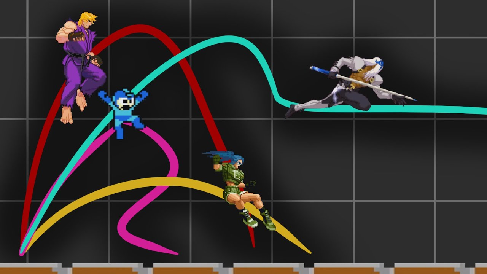
Of course not! The fun in these games lies in mastering the control system, timing jumps precisely, and feeling a sense of accomplishment when overcoming a tough challenge. Here, realism becomes an obstacle that hinders the fun instead of enhancing it
Giving up absolute physical accuracy, and relying instead on simplified, satisfying gameplay mechanics, gives the experience a feeling of control and empowerment, which forms the core of the fun in this category of games
If we look at fighting games, we'll find the same logic applied even more clearly
Do you see someone throwing punches weighing hundreds of kilograms in the real world with blazing speed and stunning accuracy? Of course not! But in fighting games, this deliberate exaggeration of realism adds another dimension of fun—it allows for jaw-dropping, spectacular moves, and shifts the focus to strategy and skill in execution rather than being bound by the constraints of reality
In the end, our goal is to find the balance between realism and gameplay fun, not to blindly stick to one at the expense of the other